Siddhayoni Asana (Sexual Energy Sublimation for Women): Procedure, Benefits, Precautions

The meaning of the word “yoni” in Sanskrit is ‘womb’ or the ‘source.’ Siddhayoni Asana is a special asana for women that according to the theory of Yoga, stimulates the sexual energy stored in the mooladhara chakra and directs it upwards towards higher energy centers.
Mention In Scriptures
The Siddha Yoni Asana is a female variant of male asana called Siddha asana. The praise of siddha asana is done in Hatha Pradipika from verse 35-44. Down below are few verses from that book extoling the many powers and virtues associated with this asana.

Translation: "Out of the 84 Âsanas Siddhâsana should always be practised, because it cleanses the impurities of 7,000 nâdîs" [1].

Translation: "By contemplating on oneself, by eating sparingly, and by practising Siddhâsana for years, the Yogî obtains success" [1].
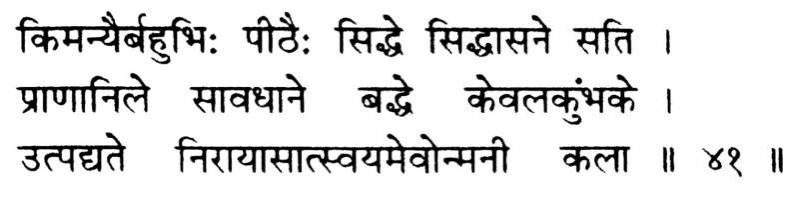
Translation: "Other postures are of no use, when success has been achieved in Siddhâsana, and Prâna Vâyû becomes calm and restrained by Kevala Kumbhaka" [1].
Procedure
- Sit with your leg straight in front of your body. Next, bend your right leg and place the sole of the right foot against the inner left thigh.
- Place the heel of this right foot firmly against the labia majora of vagina.
- Make adjustments so that your body feels comfortable but ensure that a feeling of pressure of the right heel is still felt.
- Bend your left leg and place your left heel directly on top of your right heel so that it gently presses the clitoris. Then position your left toe such that it fits into the space between the calf and thigh and also almost touch the floor.
- Now hold the toes of your right foot and pull them into the space between the left calf and thigh.
- All the while keeps adjusting your position to make sure you are not straining yourself or feeling uncomfortable.
- Make sure that both your knees touch the ground like in fig. 1.
- Now as you attain this posture back sure that your back is straight, and the spine is fully erect.
- Your hands should be placed on your knees in either chin mudra or jnana mudra. Then, close your eyes and relax your whole body.
Duration
Start with 10 to 15 minutes of holding this pose. If your feel comfortable you can stretch it to 30 minutes. While holding this pose you can either close your eyes and focus on your breath or you can do pranayama, Dhyana or japa. Combining this pose with either of three above will significantly enhance their impact and benefits.
Make sure that you get out of this pose slowly by first straightening right leg in front of you and then left leg. Then stand up slowly. Also, in the beginning the pressure felt at perineum might be uncomfortable but it eases as the practice continues.
Props (Alternate Method)
Some people may find it difficult to handle the pressure applied where the ankles cross each other in Siddhayoni. In that case, place a folded cloth between the legs at this place.
Siddhayoni Precautions
- Avoid practicing this asana if you suffer from injuries of the spine, hips, ankle or knees.
- Do not perform this if you have sciatica or sacral infections.
- Avoid practicing this if you have arthritis as it might increase the inflammation.
Siddhayoni Benefits
- Siddhayoni asana helps in directing the flow of energy from lower energy centers to higher energy centres through the spinal column.
- It helps in calming the nervous system.
- It helps in increasing brain power.
- It automatically triggers vajroli/sahajoli mudra.
- It helps in directing sexual energy back up the spinal cord to the brain.
- It helps in maintain brahmacharya for spiritual purposes.
- It helps in rebalancing the praninc flow in the lower chakras.
- In Siddhayoni asana, the heels exert pressure against the perineum may help in releiveing issues associated with the prostate like bladder control.
- It helps in strengthening pelvis, knees, and ankle joints.
- It helps in relieving stiffness in the hips, groin and thighs.
- It helps in relieving blood flow around abdomen, groin, and legs.
For more articles on the concept of sexual energy see this section.
References
- (All the verse translations in the article are by Pancham Sinh) Book: Hatha Yoga Pradipika Translated by Pancham Sinh.
- Book: Hatha Yoga – The report of a personal experience, by Theos Bernard
- Book: Gheranda Samhita – A treatise on Hatha Yoga, translated by Sris Chandra Vasu
- Book: Asana Pranayama Mudra Bandha by Swami Satyananda Saraswati

A sanctuary dedicated to authentic inquiry into Yoga, Tantra, Pranayama, and Vedic scriptures. Guided by classical texts and sincere spiritual seekers.
Comments & Reflections (0)
No comments yet on this article. Share your reflection or questions below!
Leave a Comment
Your email address will not be published. Questions regarding spiritual practices are welcomed.
Related Articles in Guides
 Guides
Rahu Kaal Today: Complete Guide to Rahu Kaal Timings by City in India and Around the World
Rahu Kaal is one of the most commonly referenced periods in traditional Hindu timekeeping. People who follow Vedic astrology and Panchang traditions often check Rahu Kaal before beginning an important activity, especially when they want to ...
 Guides
Meditation for Kids: A Simple Guide to Help Your Child Relax and Focus
In today’s fast-paced world, kids often experience stress and anxiety, just like adults. That’s where meditation for kids comes in. Meditation is a simple and effective way to help children calm their minds, manage their emotions, and impro...
 Guides
Meditation and Its Methods: Learn Powerful Ways To Change Your Life
Did you know that regular meditation can significantly reduce stress, improve focus, and enhance overall well-being? Meditation and its methods, ancient practices rooted in various spiritual traditions, have gained widespread popularity as ...